

CASE STUDY
AI-Powered Tool for Smarter YouTube Targeting
The Challenge
Managing and analyzing multiple YouTube channels shouldn’t require costly APIs or complex AI setups.
Imagine you’re putting together a list of 500 YouTube channels where you’d like your ads to appear. The catch is you don’t really know which of those channels align with your brand or which might get you in trouble with ad policies. The risk? Running ads on the wrong channel could even lead to restrictions or a ban.
For media buyers and performance marketers who rely on real-time, actionable insights, efficient, cost-effective tools are essential. That’s why we built a lightweight utility that gathers and organizes key YouTube channel data without consuming quota-heavy APIs or AI prompt credits.
The tool is built directly on Google’s native ecosystem, which makes it easy to adopt and removes the friction of a steep learning curve. By working inside familiar spreadsheets, you can quickly turn a plain list of links into something meaningful and actionable.
The Analysis
1. Pulling 5 random videos from the channel and writing out 3 titles from those videos.

2. Detecting language and the type of video based on context
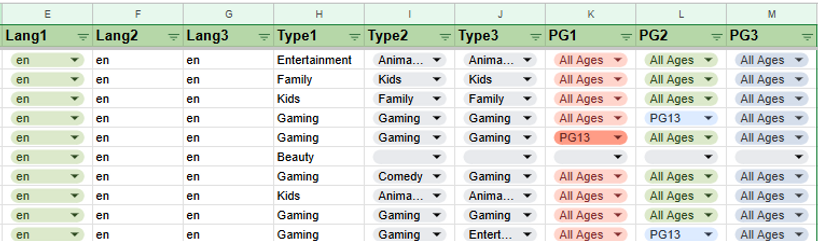
3. Decision-making on whether the channel is suitable or not for your advertisement
Key channel details flow automatically into your workbook, giving you a clear view of credibility, relevance, and safety at scale. Instead of manually checking hundreds of channels, you can instantly see the language or market the channel serves, its PG rating, and whether its content truly matches the type it is registered under with YouTube. This frees you to focus on strategy rather than technical overhead.
The Result
AI adds another layer of efficiency by packing the spreadsheet with structured data objects pulled directly from the YouTube database. This ensures zero hallucinations, provides contextual analysis, and keeps costs virtually nonexistent since it keeps the prompting technical and contextual. Additionally, the tool itself is open to switching between different AI models if needed, making it agile, versatile, and future-proof as well as open to possible edits with more complex AI models to provide more contextual analysis if the client so desires.
The result: faster decision-making, better resource allocation, and smarter YouTube marketing outcomes, while significantly reducing the time needed to filter channels according to brand guidelines.